Introducing the CONNECT GTM and CONNECT Accelerator Models
At Connect CE Consulting, a lot of what we do comes back to experience.
Over many years working in consumer electronics, we’ve been involved in launching new brands and products, developing categories, building routes to market, working with retailers, growing established businesses and helping brands respond when performance isn’t going in the right direction.
One thing that experience teaches you is that there is rarely one single reason why a brand succeeds or fails.
A great product helps, of course, but product alone isn’t enough. Market opportunity, proposition, pricing, margin, distribution, retail relationships, merchandising, availability, training, activation and organisational capability all have to connect.
That thinking has led us to develop two proprietary Connect CE models: the CONNECT GTM Model and the CONNECT Accelerator Model.
Together, they provide a structured and fully scored way of looking at two very different commercial challenges.
CONNECT GTM: from category opportunity to commercial scale
The CONNECT GTM Model is designed for businesses entering a new market, launching a new proposition or looking to establish a new route to market.
It starts with a relatively simple question: is there a genuine commercial opportunity here and are we actually ready to deliver it?
The model assesses seven connected areas:
Category & Customer Opportunity, Offer & Portfolio, Numbers & Commercial Case, Network & Route to Market, Execution & Customer Experience, Capability & Launch Readiness, and Track, Learn & Scale.
Conveniently, they spell CONNECT, but more importantly they reflect the things we believe have to work together for a successful launch.
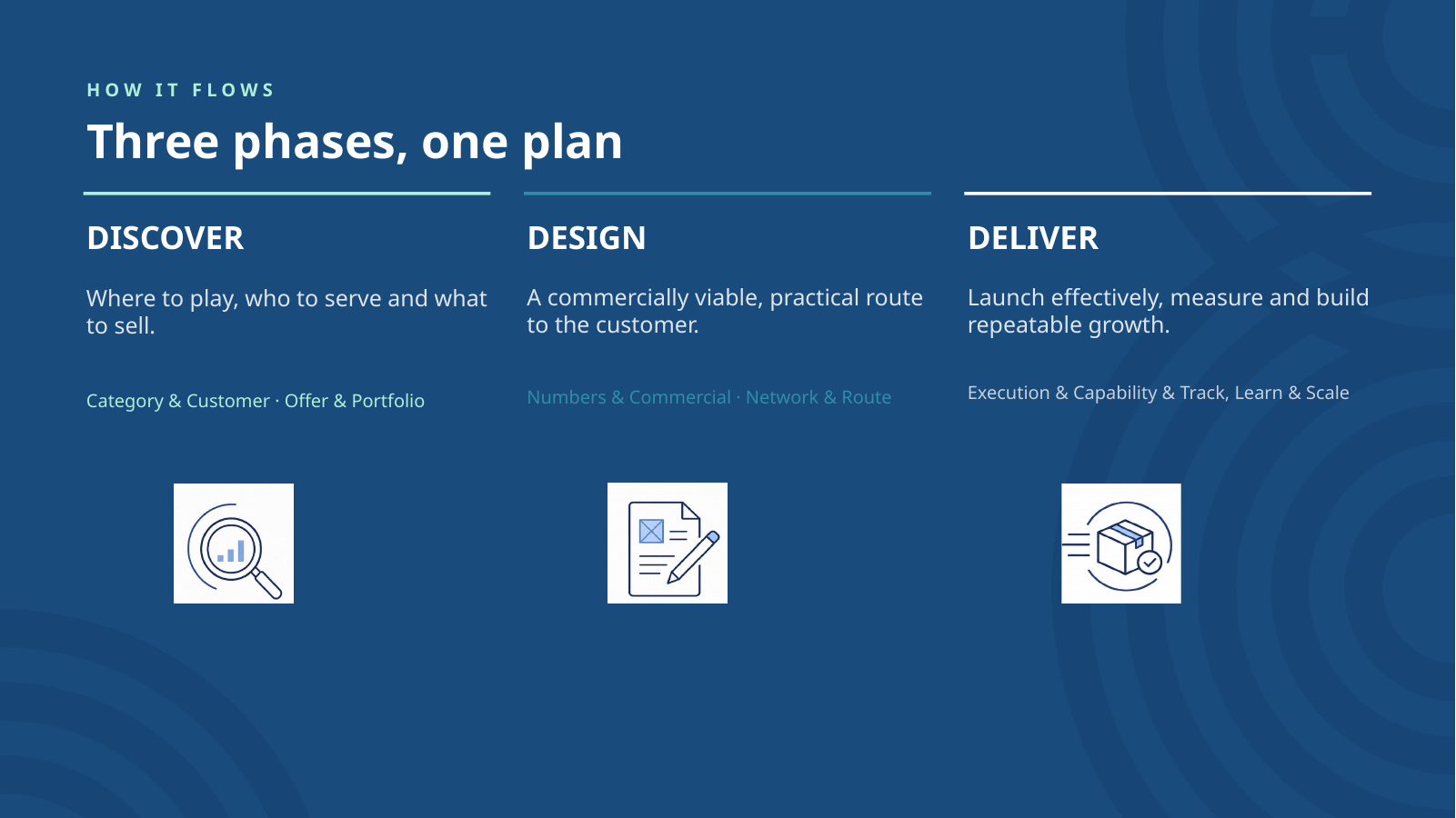
The process moves through three stages: Discover, Design and Deliver.
Discover establishes where to play, who to serve and what to sell. Design turns that opportunity into a viable commercial model and route to market. Deliver focuses on actually launching, executing, measuring performance and creating repeatable growth.
This last part is particularly important to us.
Many go-to-market frameworks are very good at market analysis and strategy. We wanted ours to continue into the practical commercial and retail layer where launches often succeed or fail.
That means looking at retailer economics, distribution, key accounts, range and pricing, packaging and communication, merchandising and demonstration, training, activation, stock availability and sell-through data.
In other words, not simply “What should we do?”, but “Will it actually work?”
CONNECT Accelerator: from market performance to sustainable growth
Once a brand is established, the questions change.
The issue may no longer be how to enter a market. It could be how to maintain momentum, recover lost performance, protect an existing position or find the next meaningful source of growth.
That is where the CONNECT Accelerator Model comes in.
The Accelerator assesses a business across three core dimensions:
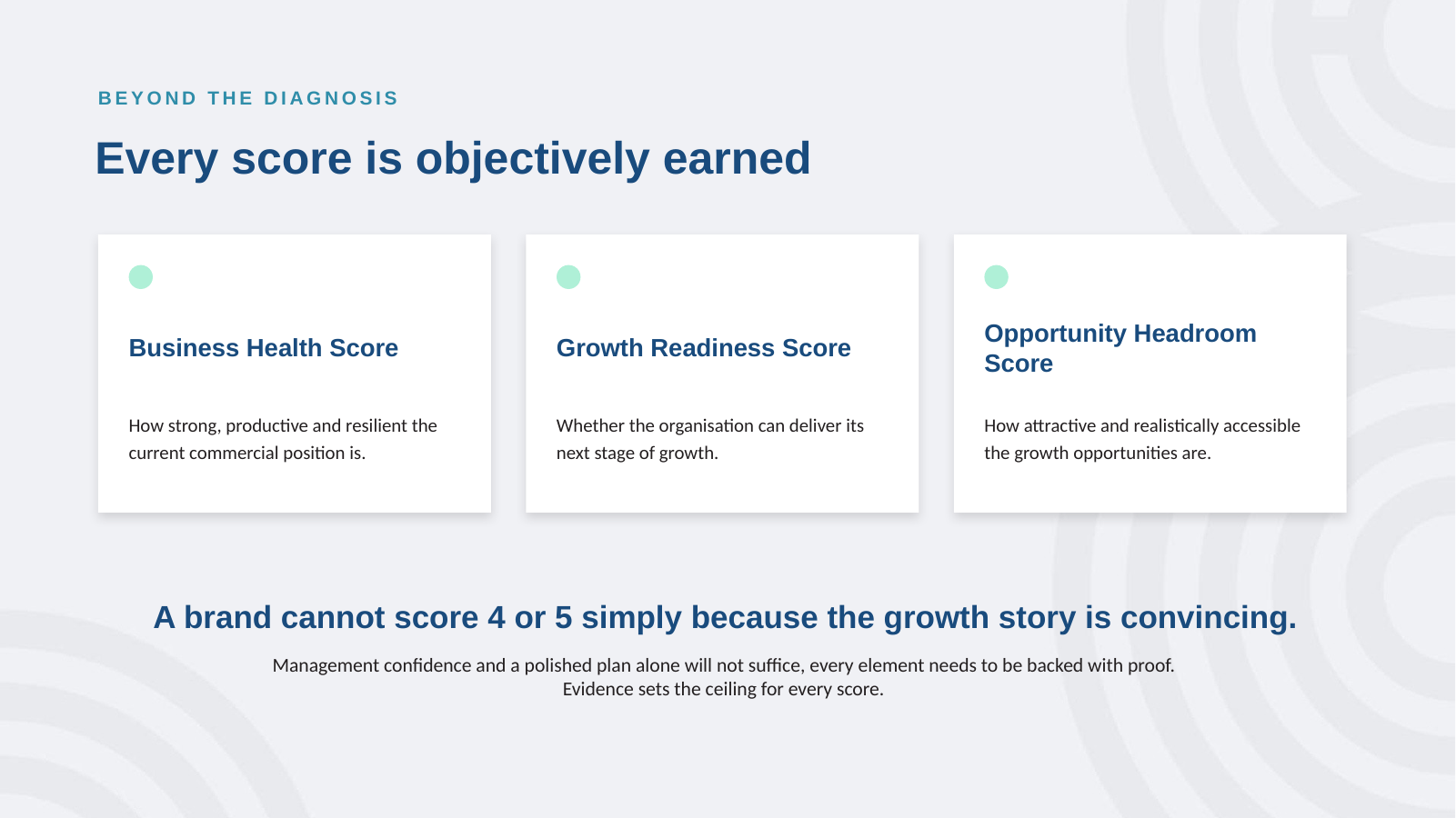
Business Health looks at how strong, productive and resilient the current commercial position is.
Growth Readiness assesses whether the organisation is genuinely capable of delivering its next stage of growth.
Opportunity Headroom identifies where the most attractive and realistically achievable growth opportunities exist.
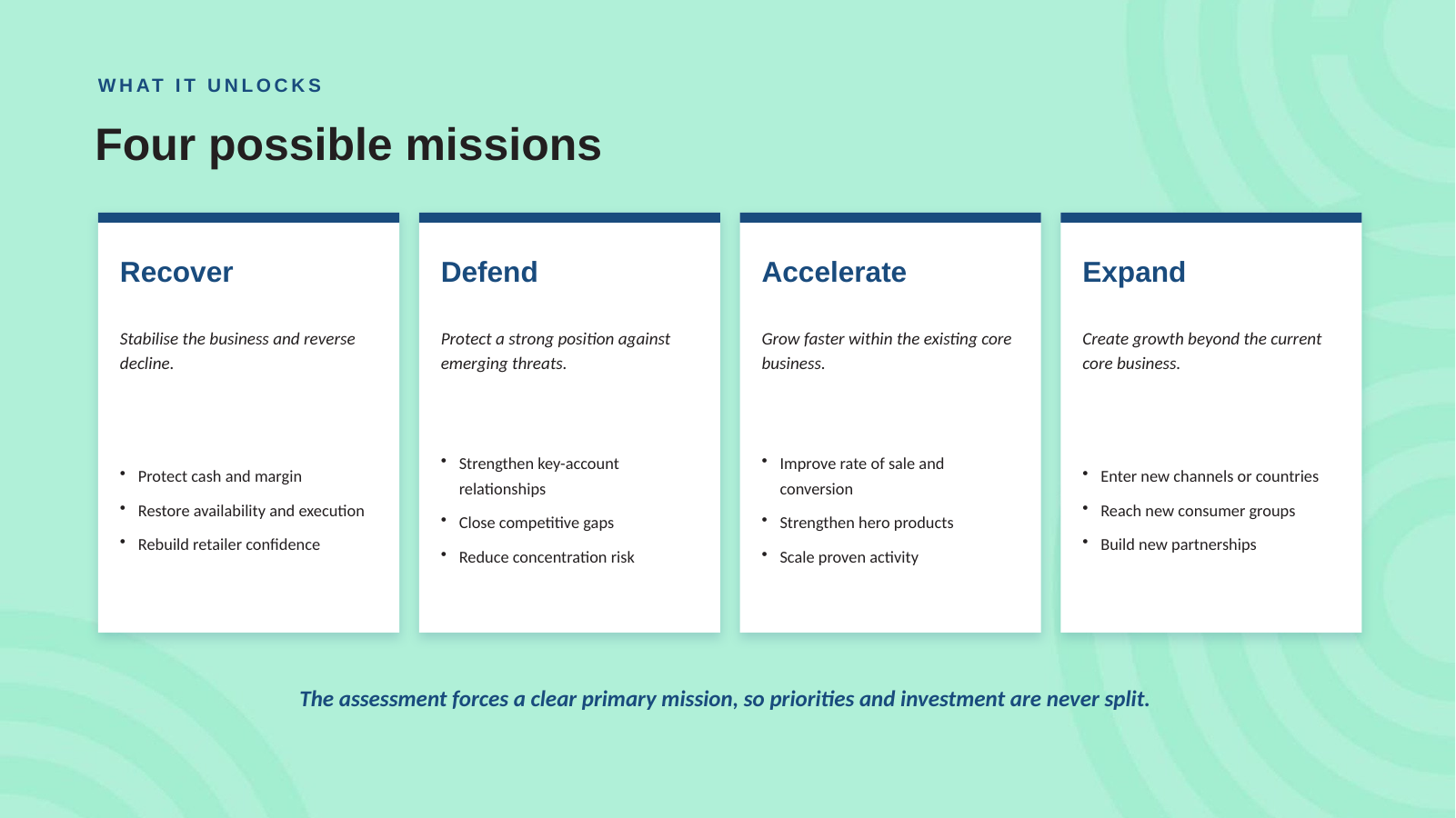
From that assessment, the model identifies one clear primary mission.
That may be to Recover, stabilising the business and reversing decline.
It may be to Defend, protecting a strong position against emerging threats.
It could be to Accelerate, driving faster growth from the existing core business.
Or it may be to Expand, moving into new channels, countries, consumer groups or partnerships.
The important part is that the model forces prioritisation. Trying to recover, defend, accelerate and expand at the same time usually results in investment and attention being spread too thinly.
Fully scored and evidence-led
One of the biggest differences between these models and a traditional consulting framework is that they are fully scored.
We don’t want the output to simply be a collection of opinions around a table.
Within the GTM Model, we assess GTM Readiness, Evidence Confidence and Critical Risk. A business may have a compelling story, but confidence in that story has to be supported by evidence.
The Accelerator applies the same philosophy across Business Health, Growth Readiness and Opportunity Headroom.
In both models, evidence matters.
A confident management view cannot simply earn a top score because everybody believes in the plan. Higher scores have to be supported by proof.
Both models also use critical gates.
For GTM, these include commercial viability, compliance, supply, route to market and ownership.
For the Accelerator, the gates cover areas including commercial sustainability, consumer relevance, channel access, supply, ownership and measurement.
So a headline score on its own never tells the whole story.
The result is intended to be a clear commercial verdict, highlighting strengths, weaknesses, risks and, most importantly, the priorities that should come next.
Built by operators, not theorists
We’ve deliberately built these models around practical experience.
They come from years spent buying, selling, launching and developing consumer electronics brands, working with retailers, building propositions and dealing with the realities of commercial execution.
That is why both models go beyond strategy.
The objective isn’t simply to produce another presentation. It is to provide a structured way of identifying where a business really is, where the opportunity genuinely exists and what needs to happen next.
Both models can also be accessed at different levels through our Quick Charge, Power Up and Plugged In services, from an initial diagnostic through to strategy development and embedded delivery support.
For a new entrant that might mean going from category opportunity to launch readiness and commercial scale.
For an established brand it might mean identifying why growth has stalled and whether the next priority is to recover, defend, accelerate or expand.
Different starting points, but the same basic principle:
Evidence first. Clear priorities. Practical commercial execution.
If you’d like to find out more about either the CONNECT GTM Model or CONNECT Accelerator Model, get in touch with Connect CE Consulting.